Quick answer: How does an air fryer work? A heating element warms the air inside a small chamber. A fan then blows that hot air around your food at high speed. The moving air dries the surface and browns it. That is why food turns crisp with only a little oil.
Read on for a simple diagram, a parts table, what you can and cannot cook, fixes for common problems, and a full FAQ.
How does an air fryer work? It is simpler than most people think. An air fryer is a small countertop oven with a strong fan. The fan moves very hot air around your food. That air crisps the outside and keeps the inside soft.
The name is a bit misleading. An air fryer does not cook food in a pool of oil. Experts describe it as a high-intensity convection oven. That is the best way to picture it.
In this guide, you will learn what an air fryer is and how each part works. You will see why food gets crisp. You will also learn how an air fryer oven works, how air frying works in a regular oven, and what you can and cannot cook. You will not need to visit another website to understand the basics.
Want to see the oven style in a real kitchen? Check our list of the best countertop air fryer oven combos.
What Is an Air Fryer and How Does It Work?
An air fryer is a small countertop appliance that cooks with moving hot air. It copies the crisp finish of deep frying. But it does not need a pot of oil.
Here is the short version of what an air fryer is and how it works. A heating element makes heat. A fan pushes that heat around. A vented basket lets the air reach every side of the food.
BBC Science Focus Magazine explains that the heating element sits near the top of the unit. It heats the air in the cooking chamber. The fan then moves that air quickly around the food. Together, this gives a very intense kind of heat transfer. You can read the full explainer on the BBC Science Focus website.
Diagram: How Does an Air Fryer Work?
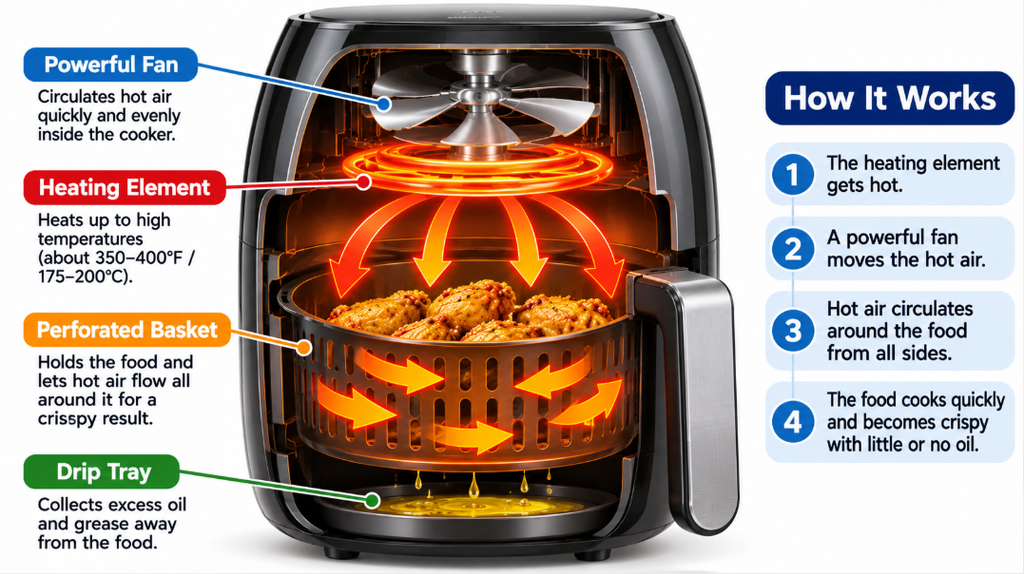
This simple side view shows how air moves inside a basket-style air fryer. Follow the arrows from top to bottom.
Inside an air fryer (side view)
Makes the heat
Pushes the hot air down and around
Air flows over, under and around the food
Catches drips and crumbs
The air then loops back to the top and gets heated again.
That loop is the whole secret. The same hot air keeps moving past the food. In a small chamber, this gives fast and even heat.
Main Parts of an Air Fryer
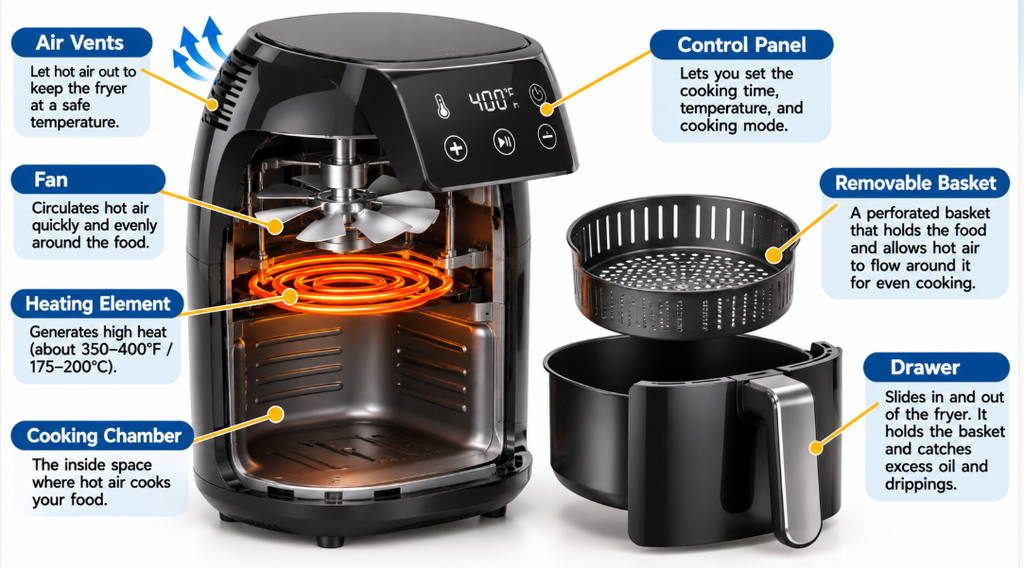
| Part | What It Does | Good to Know |
|---|---|---|
| Heating element | Makes the heat. It is often near the top. | Keep food and loose paper away from it. |
| Fan | Moves the hot air fast around the food. | A strong fan can lift very light food or liners. |
| Cooking chamber | The small space where the food cooks. | A small space heats up quickly. |
| Basket or rack | Holds the food. Holes or vents let air pass through. | Do not overfill it, or the air cannot move. |
| Drawer or tray | Catches drips, grease and crumbs. | Empty and wash it after cooking. |
| Controls | Set the time and the temperature. | Many models also have presets. Check your manual. |
| Vents | Let hot air and steam out. | Leave open space around the unit. |
How Does an Air Fryer Work Step by Step?
- You set the time and temperature. Many models let you pick a preset too.
- The heating element warms the air. The air inside the small chamber heats up fast.
- The fan starts moving the air. It pushes the hot air around the chamber at high speed.
- Air passes through the basket. Holes and vents let it flow over, under and around the food.
- The surface loses water. Moving hot air dries the outside of the food.
- The surface browns. Heat changes the sugars and proteins, and a golden crust forms.
- Fat drips away. Grease falls into the drawer instead of soaking back into the food.
- The air loops back. It returns to the element and gets heated again until the timer ends.
The Science: Why Air Fryer Food Gets Crisp
Fast airflow
Speed matters most. Séamus Higgins, a food process engineer at the University of Nottingham, says the air in most air fryers moves at about 70 mph. This was reported by the engineering magazine Ingenia. Fast air moves heat into the food quickly. You can read the full article on the Ingenia website.
Surface drying
Crispy food has a dry outside. As the surface heats up, water turns to steam and leaves. What remains is a thin, crunchy layer. Wet food has trouble getting crisp, because water keeps the surface cooler.
The browning reaction
Browning comes from the Maillard reaction. This is a group of many chemical reactions between sugars and proteins. It gives food its golden color and its roasted smell. A thin coat of oil and a dry surface both help it along. BBC Science Focus says the reaction can start sooner in an air fryer than in a regular oven, because the heat transfer is so intense.
A small chamber
An air fryer has a small cooking space. Ingenia notes that the air volume is about 1 to 6 liters, compared with about 60 liters in a standard oven. Less air to heat means a faster start and a shorter cook time.
How Does an Air Fryer Oven Work?
An air fryer oven looks like a toaster oven. It has a front door, a few racks, and a fan. It uses the same idea as a basket model. A heating element makes heat. A fan pushes that heat around the food.
The main change is size. An air fryer oven has more room, so you can cook more food at once. Many models also bake, broil and toast. Because the space is larger, the air often does not move as hard as it does in a small basket unit. Food can take a little longer, so check it early.
Looking for one? These guides can help you compare options: the best Breville air fryer toaster oven, the best budget air fryer toaster oven, and the best air fryer microwave combo.
How Does Air Fryer Work in an Oven?
This question has two meanings. Here are both answers.
1. Your oven has an air fry or convection mode. Some full-size ovens have a fan and an air fry setting. The fan moves hot air through the oven. Many of these ovens come with a perforated tray, so air can reach the bottom of the food.
2. You use an air fry tray in a regular oven. A tray with holes lets hot air flow under the food. It can help a regular oven crisp food better than a solid pan.
Keep one thing in mind. A big oven has a large space. BBC Science Focus says the air in a convection oven does not move as fast and does not heat food as intensely as in an air fryer. So results can be a little less crisp, and cooking can take longer.
- Use the rack position that your manual suggests.
- Spread food in one layer on a perforated tray.
- Do not cover the whole tray with foil. It blocks the air.
- Check the food early. A common tip is to lower the oven temperature by about 25°F (15°C) when you move a recipe from a fryer to an oven, or the other way around, and then watch it closely.
Air Fryer vs Air Fryer Oven vs Convection Oven vs Deep Fryer
| Feature | Basket Air Fryer | Air Fryer Oven | Convection Oven | Deep Fryer |
|---|---|---|---|---|
| How it cooks | Fast hot air in a small chamber | Hot air with a fan, in a box with racks | Hot air with a fan, in a large space | Food sits in hot oil |
| Oil needed | Little or none | Little or none | Little or none | A lot |
| Size | Small countertop unit | Medium countertop unit | Full-size, built in | Countertop or larger |
| Heat-up | Fast | Fairly fast | Slower | Needs time to heat the oil |
| Best for | Small batches and crisp snacks | Bigger meals and baking | Large batches and roasts | Classic deep-fried food |
What You Can and Cannot Do With an Air Fryer
An air fryer uses dry heat. That shapes what it does well. Here is a simple guide. Green is something you can do. Red is something to avoid.
| ✔ You Can | ✘ You Cannot / Should Not |
|---|---|
| Crisp frozen fries, nuggets and other frozen snacks. | Boil or steam food the way a pot does. |
| Reheat leftovers and bring back the crunch. | Cook foods that must sit in liquid, such as soup, rice or pasta, straight in the basket. |
| Roast vegetables with a light coat of oil. | Pour in a pool of oil to deep fry. It is not made for that. |
| Cook chicken pieces, wings and bacon. Fat drips away. | Use wet batter. It drips through the basket and makes a mess. Use a dry coating like breadcrumbs instead. |
| Bake small items, if your model and its manual allow it. | Overfill the basket. Air needs room to move. |
| Shake the basket or flip the food halfway for even color. | Use loose paper or light liners. The fan can lift them toward the heating element. |
| Cook small batches fast on a busy night. | Cook a very large roast or a huge family batch at once. It will not fit well. |
Pros and Cons of Air Frying
| ✔ Pros | ✘ Cons |
|---|---|
| Heats up fast because the chamber is small. | Small capacity in most basket models. |
| Gives a crisp finish with little oil. | Big meals need several batches. |
| Can use less energy than a full oven for small meals. | Energy savings shrink when you cook in batches. |
| Sits on the counter, so no oven space is needed. | Takes counter space and needs open room around it. |
| Removable parts are easy to wash on many models. | Grease can build up and cause smoke if you skip cleaning. |
| Crisp results for frozen and leftover food. | Wet foods and wet batters do not work well. |
Is Air Fryer Food Healthier?
It can be. The change comes from the method. BBC Science Focus points out that the food is the same. But there is far less oil involved. Oil adds calories as it soaks into food. Air frying uses much less of it.
Still, fries are fries. A chicken breast or a tray of vegetables will always be a lighter pick than a heavy battered snack. Choose the food first, then the cooking method.
Does an Air Fryer Save Energy?
Often, yes. The UK consumer group Which? looked at the power used to cook a range of foods. Ingenia reports that the air fryer used less than half the energy of an oven. Higgins adds that an average air fryer draws about 1.5 to 2 kilowatts, close to a kettle. A typical oven draws about 3 to 4 kilowatts.
There is one catch. The savings fall away when you cook in batches. For a big family dinner, a full oven may make more sense.
Tips for Crispy Air Fryer Food
- Pat the food dry. A dry surface browns faster.
- Use a light coat of oil. A small amount helps browning. Some makers warn against aerosol sprays on nonstick baskets, so check your manual.
- Cook in one layer. Air must reach every side.
- Do not overcrowd. Cook two small batches instead of one packed basket.
- Shake or flip halfway. This gives even color on all sides.
- Cut food to the same size. Equal pieces finish at the same time.
- Check early. Air fryers cook fast. Look a few minutes before the timer ends.
- Know your preheat rule. Some makers say you do not need to preheat. Others suggest a few minutes. Follow your manual.
Safety Tips for Air Fryers
Safety note: Food looks done before it is safe. Use a food thermometer. The USDA lists these safe minimum internal temperatures: 165°F (74°C) for poultry, 160°F (71°C) for ground meats, and 145°F (63°C) for steaks, chops and roasts, plus a 3 minute rest. Fish should reach 145°F (63°C) too.
Find the full chart on the FoodSafety.gov website.
- Leave open space around the air fryer so hot air and steam can escape.
- Place it on a flat, heat-safe counter.
- Do not leave it running with nobody home.
- Keep paper, foil and light items from flying into the heating element.
- Unplug it and let it cool before you clean it.
- Read the manual. Each model has its own rules.
Common Air Fryer Problems and Easy Fixes
| Problem | Easy Fix |
|---|---|
| Food is not crispy | Pat it dry, use less food, and cook in one layer. |
| Food is dry | The time was too long or the heat too high. Check earlier next time. |
| Uneven cooking | Shake the basket or flip the food halfway. Cut pieces to the same size. |
| Burnt outside, raw inside | Lower the heat and cook a little longer. Cut thick pieces smaller. |
| White smoke | Old grease or very fatty food is the usual cause. Clean the drawer and pour out grease between batches. |
| Light food flies around | Place a heavier food on top, or use a rack made for your model. |
| Bad smell | Food residue is burning. Wash the basket, drawer and chamber when cool. |
How to Clean an Air Fryer
- Unplug the air fryer and let it cool.
- Remove the basket and drawer.
- Wash them in warm water with mild soap and a soft sponge. Check your manual first to see if they are dishwasher safe.
- Wipe the inside of the chamber with a damp cloth.
- Dry every part before you put it back.
Clean it right after cooking. Old grease is hard to remove. For a deeper clean, follow our guide on the best way to clean an air fryer.
Which Type of Air Fryer Should You Choose?
Now that you know how an air fryer works, the right type is easier to pick. Match the style to how you cook.
| Type | Good For | Read Our Guide |
|---|---|---|
| Air fryer oven | Bigger meals, baking and toasting | Countertop air fryer oven combos |
| Toaster oven style | Smaller kitchens and tighter budgets | Budget air fryer toaster ovens |
| Smart oven brand | People who want one oven for many jobs | Breville air fryer toaster ovens |
| Microwave combo | Reheating and crisping in one box | Air fryer microwave combos |
| Ceramic coated | Easy cleanup | Ceramic air fryers |
| Glass bowl | Watching food as it cooks | Glass air fryers |
Easy Foods to Try First
Start with simple food. Frozen fries and vegetables are very forgiving. When you feel ready, try these guides:
- How to cook bacon in an air fryer
- Juicy air fryer pork chops
- Easy air fryer meals for busy nights
- Air fryer cookbooks for beginners
Frequently Asked Questions
How does an air fryer work in simple words?
It heats air and blows it fast around your food. The moving air dries the surface and browns it. The result is a crisp outside with little oil.
Does an air fryer use oil?
It needs little or none. Many foods only need a light coat of oil to brown well. Foods that are already fatty, like bacon or chicken wings, may need none.
Is an air fryer the same as a convection oven?
They work on the same idea: a fan moves hot air. But an air fryer has a smaller chamber, so the air moves faster and the food heats more intensely. A convection oven is better for large batches.
How does an air fryer oven work?
It uses a heating element and a fan, just like a basket model. The difference is the box. It has a front door and racks, and it holds more food. Many models can also bake, broil and toast.
How does air fryer work in an oven?
If your oven has an air fry or convection mode, a fan moves hot air through the oven. A tray with holes helps the air reach the bottom of the food. A large oven moves air more slowly than a small air fryer, so food may take longer and brown a little less.
Do I need to preheat an air fryer?
It depends on the model. Some makers say it is not needed because the chamber is small. Others suggest a few minutes of preheating. Check your manual and your recipe.
Why is my food not crispy?
The basket may be too full, or the food may be wet. Pat the food dry, cook in one layer, and shake or flip it halfway.
Can I use foil or parchment paper in an air fryer?
Only if your manual allows it. Use liners made for air fryers, and keep them weighed down by food. Never leave loose paper or foil in the chamber. The fan can lift it toward the heating element. Do not cover the whole basket, because that blocks the airflow.
Is air fryer food healthier?
The method uses much less oil than deep frying, so it can cut calories. The food itself stays the same. A lean protein or a tray of vegetables is still a lighter choice than a heavy fried snack.
Can I cook frozen food in an air fryer?
Yes. Many frozen snacks, like fries and nuggets, go in straight from the freezer. Follow the package directions and shake the basket halfway through. Always check that meat reaches a safe temperature with a food thermometer.
Does an air fryer use less electricity than an oven?
For small meals, often yes. A Which? study reported by Ingenia found an air fryer used less than half the energy of an oven. The savings fall when you cook in several batches.
Are air fryers safe to use?
Yes, when you follow the manual. Keep open space around the unit, do not overfill the basket, keep loose items away from the heating element, and unplug it before cleaning.
Final Words
Now you know how an air fryer works. A heating element makes heat. A fan moves that hot air at high speed through a small chamber. A vented basket lets the air touch every side of the food. The surface dries, browns and turns crisp.
Remember a few simple rules. Cook in one layer, keep the food dry, and check it early. Clean the drawer often. With a little practice, you will get crisp results from your air fryer, air fryer oven or even your regular oven.
Related reading on MiniKitchenPro