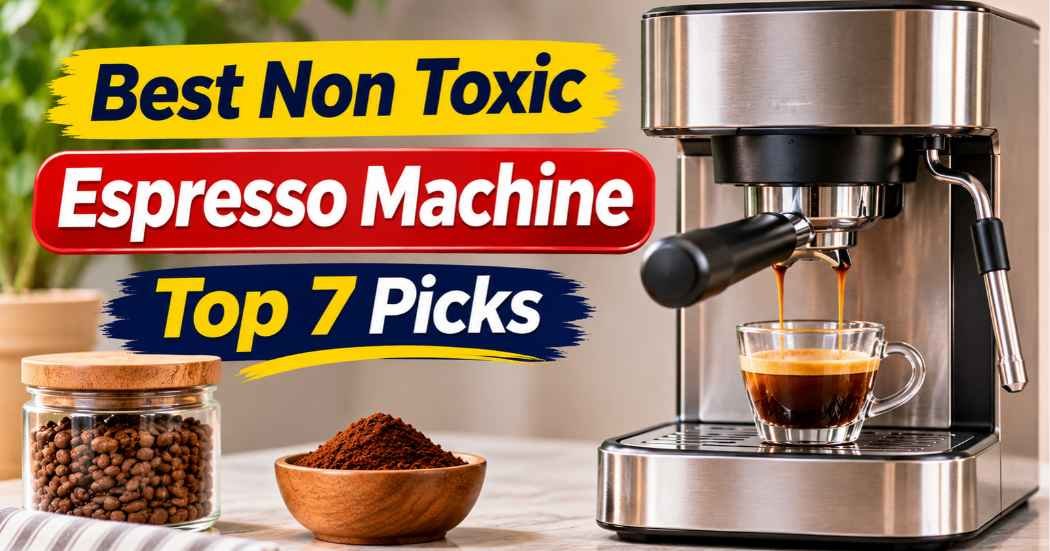
The best non toxic espresso machine keeps your coffee water away from materials you would rather not drink. That means a stainless steel boiler or heater, a metal portafilter, and a water path made without PFAS where the brand says so. It also means a machine you can clean and descale with ease, because old scale and milk residue are a hygiene problem of their own.
Almost no espresso machine brand prints full test results for its water path. Most listings only name the outside material. So this guide sticks to what each listing actually says, and it tells you plainly when a listing makes no safety claim at all.
We compare 7 machines from CASABREWS, Breville, Gaggia and De’Longhi. Each pick has key features, pros and cons, what makes it good, and who should skip it. You also get a material checklist, a buying guide, safe use tips and a full FAQ. We did not test these machines ourselves. Every spec comes from the product listing and the brand’s own claims.
Quick answer: The CASABREWS 5418 MAX is the best non toxic espresso machine on this list. It is the only pick whose listing says it has a fully PFAS-free internal water path. It also has a solid aluminum portafilter, PID temperature control, pre-infusion and a pressure gauge.
Want a steel-housed machine you can repair yourself for years? Get the Gaggia Classic E24. Want beans to espresso in one machine? Get the Breville Barista Pro, which has a built-in burr grinder and a 2 year warranty.
Want a simple starter with a stainless steel boiler? The De’Longhi Stilosa is the easy pick.
Top 7 Picks at a Glance: Best Non Toxic Espresso Machine
Here are all 7 machines in the order we review them. Each has a “best for” label so you can find your fit fast.
- CASABREWS 5418 MAX PFAS-Free (best overall non toxic pick)
- Gaggia Classic E24 (best steel-housed, repairable machine)
- Breville Barista Pro BES878BSS (best with a built-in grinder)
- De’Longhi Stilosa EC260BK (best simple starter with a stainless boiler)
- CASABREWS Ultra (best big tank and brew temp control)
- CASABREWS 3700 Essential (best slim stainless machine)
- CASABREWS CM5418 (best budget-style pick with a pressure gauge)


What Makes an Espresso Machine Non Toxic?
Hot water under pressure touches many parts before it hits your cup. The tank, the pump, the tubes, the boiler or heater, the group head and the portafilter all count. Heat can make some materials release more into water than they would when cold. That is why people care about what is inside.
These are the things most buyers look at:
- PFAS. These are long-lasting chemicals used in some nonstick coatings, tubing and seals. The EPA explains what PFAS are and why they break down so slowly.
- Plastic in the hot water path. Plastic water tanks hold cold water, which is less of a worry. Plastic parts that touch hot water matter more.
- Boiler or heater material. Stainless steel is the common “clean” choice. Aluminum and brass are also used in many machines.
- Lead in brass. Brass can contain small amounts of lead. In the U.S., the EPA defines plumbing as “lead free” at a weighted average of 0.25% lead on wetted surfaces. None of the listings here say whether their brass parts meet that rule.
- Ease of cleaning. Scale, old coffee oils and dried milk can build up. A machine you can clean well is a safer machine to use every day.
Honest note: “Non toxic” is not a legal or tested label for espresso machines. Only one listing in this guide (the CASABREWS 5418 MAX) makes a PFAS-free claim. For the others, we rank them by the materials their listings name. If a material matters a lot to you, ask the brand for the water path parts list before you buy.
Comparison Table: Materials and Specs Side by Side
All facts come from each Amazon listing. Check the product page for the latest details before you buy.
| No. | Model | Listed Material | Safety Claim in Listing | Portafilter |
|---|---|---|---|---|
| 1 | CASABREWS 5418 MAX | Brushed stainless steel, thermal-ceramic parts | Fully PFAS-free internal water path | Solid aluminum, 51mm baskets |
| 2 | Gaggia Classic E24 | Brass, plastic, stainless steel; solid steel housing | None | 58mm stainless steel, commercial |
| 3 | Breville Barista Pro | Stainless steel | None | Not listed (includes water filter) |
| 4 | De’Longhi Stilosa | Plastic, stainless steel; stainless steel boiler | None | Not listed |
| 5 | CASABREWS Ultra | Brushed stainless steel | None | 58mm |
| 6 | CASABREWS 3700 Essential | Brushed stainless steel | None | 51mm |
| 7 | CASABREWS CM5418 | Brushed stainless steel | None | 51mm |
| Model | Pressure | Watts | Water Tank | Weight | Width | Warranty |
|---|---|---|---|---|---|---|
| CASABREWS 5418 MAX | 20 bar | 1550 | 34 oz | 8.6 lb | 5.47″ | 1 year |
| Gaggia Classic E24 | 9 bar extraction | 1200 | 2.1 L | 20 lb | 9.5″ | See brand PDF |
| Breville Barista Pro | Not listed (low pressure pre-infusion) | 1680 | 67 oz | 19.5 lb | 14″ | 2 years |
| De’Longhi Stilosa | 15 bar | 1100 | 1000 ml | 8.6 lb | 9.45″ | 1 year |
| CASABREWS Ultra | 20 bar | 1350 | 73 oz | 13.6 lb | 10.31″ | 1 year |
| CASABREWS 3700 Essential | 20 bar | 1350 | 43.9 oz | 8.1 lb | 6.5″ | 1 year |
| CASABREWS CM5418 | 20 bar | 1350 | 34 oz | 8.6 lb | 5.47″ | 1 year |
Top 7 Best Non Toxic Espresso Machine Reviews for 2026
1. CASABREWS 5418 MAX PFAS-Free: Best Overall Non Toxic Pick
This is the only machine on our list that makes a clear material claim. CASABREWS says the full internal water path is PFAS-free. The portafilter is solid aluminum. The heater uses stainless steel and thermal-ceramic parts.
It is also fast. CASABREWS says it reaches brew temperature in under 5 seconds. It switches to steam in about 3 seconds and back to brewing in another 3. That helps when two or three people want drinks one after another. PID control, pre-infusion and a pressure gauge give you more control than most compact machines.
Key Features
- Fully PFAS-free internal water path, per the brand.
- Solid aluminum portafilter.
- Flashheat system with stainless steel and thermal-ceramic parts. Ready to brew in under 5 seconds.
- 3-second switch between brewing and steam.
- PID temperature control and pre-infusion.
- Built-in pressure gauge.
- 20 bar pump, 1550 watts, 120 volts.
- 34 oz removable water tank.
- Very slim at 5.47″ wide. Weighs 8.6 lb.
- Comes with 51mm single wall and dual wall baskets (1 cup and 2 cup), a tamper and a needle tool.
- Uses ground coffee. 1 year warranty.
Pros and Cons
| ✔ Pros | ✘ Cons |
|---|---|
| Only pick here with a PFAS-free water path claim. | The portafilter is aluminum, not stainless steel. |
| Fast heat up and quick steam switching. | Newer model with few buyer reviews so far. |
| PID, pre-infusion and a gauge at this size. | Small 34 oz tank needs more refills. |
| Fits narrow counters at 5.47″ wide. | No built-in grinder. |
What Makes It Good
If PFAS is your main worry, this is the only listing here that speaks to it directly. The fast heater also helps flavor. A thermal-ceramic heater with PID keeps the water temperature steady, so your shots taste more even from one cup to the next. The gauge shows if your grind is too fine or too coarse.
Best for: people who want a PFAS-free water path and drinks back to back.
Skip it if: you want zero aluminum parts touching your coffee, or a big water tank.
2. Gaggia Classic E24: Best Steel-Housed, Repairable Machine
The Gaggia Classic E24 is made in Italy with a solid steel housing. It uses commercial-style parts: a 58mm stainless steel portafilter, a three-way solenoid valve and a commercial steam wand. Gaggia also calls it “self serviceable”, which means you can replace worn parts yourself.
The listing names brass, plastic and stainless steel as materials. It does not say which parts are which, and it makes no lead or PFAS claim. It brews at 9 bar, the standard pressure for espresso. It also takes ESE pods.
Key Features
- Solid steel housing. Made in Italy.
- 9 bar espresso extractions.
- 58mm stainless steel commercial portafilter.
- Commercial three-way solenoid valve. It releases pressure after the shot, so the puck comes out drier.
- Commercial steam wand for milk and latte art.
- Brews ground coffee or ESE pods.
- 2.1 liter water tank. 1200 watts, 120 volts.
- Comes with a pressurized double basket, commercial single and double baskets, a tamper and a coffee scoop.
- Model RI9380/46. Weighs 20 lb.
Pros and Cons
| ✔ Pros | ✘ Cons |
|---|---|
| Steel body and stainless 58mm portafilter. | Brass and plastic are listed, with no lead or PFAS details. |
| You can service and repair it yourself. | No PID or temperature display in the listing. |
| Large 2.1 L tank. | Heavy at 20 lb. |
| Commercial steam wand for real microfoam. | Takes more practice than a beginner machine. |
What Makes It Good
A machine you can fix lasts longer, and you can swap old gaskets and seals instead of living with worn parts. The 58mm portafilter is the same size many cafes use, so baskets and tampers are easy to find. The solenoid valve also makes cleanup quicker, because the used coffee knocks out as a firm puck.
Best for: home baristas who want a metal machine that can last for many years.
Skip it if: you want a written PFAS-free or lead-free claim, or a light machine.
3. Breville Barista Pro BES878BSS: Best With a Built-In Grinder
The Barista Pro grinds fresh beans and pulls the shot in one machine. Its listed material is stainless steel. It comes with a water filter, which helps cut scale and odd tastes from tap water. Breville makes no PFAS claim in the listing.
The ThermoJet heater reaches brew temperature in 3 seconds. Digital PID control holds the water within about 2°C. A clear LCD shows grind and shot progress. Breville says you can go from beans to espresso in under a minute.
Key Features
- Built-in conical burr grinder with adjustable settings and dose on demand.
- 1/2 lb bean hopper. Takes whole beans or ground coffee.
- ThermoJet heating: 3 seconds to brew temperature, fast switch to steam.
- Digital PID temperature control (+/- 2°C).
- Low pressure pre-infusion for even extraction.
- LCD screen with grind and shot animations.
- Powerful steam wand for hand-textured microfoam.
- 67 oz water tank. 1680 watts, 120 volts.
- Includes single and dual wall baskets, the Razor dose trimming tool, a 480 ml stainless steel milk jug, a cleaning kit and a water filter.
- 2 year limited warranty. Weighs 19.5 lb.
- Breville says you get 2 free bags of specialty coffee when you register the machine (terms apply).
Pros and Cons
| ✔ Pros | ✘ Cons |
|---|---|
| Fresh grinding and brewing in one machine. | No PFAS or water path material claim. |
| Water filter included. | Biggest footprint here at 14″ wide and 16″ tall. |
| PID and 3-second heat up. | More parts to clean, including the grinder. |
| Longest warranty on this list (2 years). | Heavy at 19.5 lb. |
What Makes It Good
Fresh ground coffee tastes better, and the grinder means you never need pre-ground bags. The included water filter matters for a cleaner cup too. Filtered water means less scale in the heater and fewer harsh descaling sessions. The 2 year warranty gives the most cover on this list.
Best for: coffee lovers who want bean-to-cup espresso in one stainless machine.
Skip it if: you have little counter space or want a written PFAS-free claim.
4. De’Longhi Stilosa EC260BK: Best Simple Starter With a Stainless Boiler
De’Longhi Stilosa EC260BK Manual Espresso Machine
View on AmazonThe Stilosa is a simple, compact machine with a stainless steel boiler. De’Longhi says the boiler is built to last for years. The water heats in steel instead of an aluminum block, which many buyers prefer.
The body is plastic with a matte finish. It uses a 15 bar pump and a manual steam wand. A dial controls it, and it turns itself off when not in use. It is one of the most popular manual machines on Amazon.
Key Features
- Stainless steel boiler.
- 15 bar pump pressure.
- Manual steam wand for lattes and cappuccinos.
- Auto shut-off.
- 1000 ml removable water tank.
- 1100 watts, 120 volts. Dial control.
- Comes with a portafilter, a measuring scoop and tamper, and single and double shot filters.
- Weighs 8.6 lb. Model EC260BK.
- 1 year warranty. Spare parts listed for 5 years in the EU.
Pros and Cons
| ✔ Pros | ✘ Cons |
|---|---|
| Stainless steel boiler. | Plastic body. |
| Very simple to use. | No PID, gauge or temperature settings. |
| Auto shut-off. | Lowest power here at 1100 watts. |
| Light and compact at 8.6 lb. | No PFAS claim in the listing. |
What Makes It Good
The stainless boiler is the main reason it is on this list. It is a plain part that De’Longhi says will last, and steel is easy to descale. The machine has few features, so there is less to break and less to learn. That makes it a sensible first espresso machine.
Best for: beginners who want a stainless boiler and simple controls.
Skip it if: you want a metal body or fine control over shot temperature.
5. CASABREWS Ultra: Best Big Tank and Brew Temp Control
The CASABREWS Ultra has a brushed stainless steel body and a 58mm portafilter. Its 73 oz tank is the largest on this list. You can set the brew temperature to one of four levels. The setting only changes espresso, not steam.
An LCD screen guides you through each step. There are buttons for steam, hot water and pre-set shots. The listing makes no PFAS or water path material claim.
Key Features
- Brushed stainless steel body.
- 58mm portafilter.
- 4 brew temperature settings for espresso.
- LCD display with step-by-step guidance.
- 20 bar Italian pump. 1350 watt heating system.
- Steam wand for microfoam and latte art.
- 73 oz removable water tank.
- Comes with single and dual wall 1 cup and 2 cup filters, a cleaning needle, a tamper with spoon, a user guide and recipes.
- Weighs 13.6 lb. 1 year warranty.
Pros and Cons
| ✔ Pros | ✘ Cons |
|---|---|
| Biggest tank here at 73 oz. | No PFAS or inner material claim. |
| 58mm portafilter, like many cafe machines. | Temperature setting does not change steam. |
| 4 brew temperature levels. | Heavier than the other CASABREWS picks. |
| Clear LCD guidance for beginners. | No pressure gauge. |
What Makes It Good
A big tank means fewer refills and less handling of the tank. The temperature settings help you tune flavor. Lighter roasts often like hotter water, and darker roasts often taste better a bit cooler. The 58mm size gives you lots of accessory choices.
Best for: busy homes that make many drinks and want a stainless body.
Skip it if: you need a written PFAS-free claim.
6. CASABREWS 3700 Essential: Best Slim Stainless Machine
The 3700 Essential is a narrow, brushed stainless steel machine. It is 6.5″ wide and weighs just 8.1 lb, the lightest pick here. It has a 20 bar pump, a 1350 watt heater and a steam wand.
The 43.9 oz tank and the drip tray both come off for easy cleaning. This version has no pressure gauge. The listing makes no PFAS or water path claim.
Key Features
- Brushed stainless steel body.
- 20 bar professional pump. 1350 watt heating system.
- Steam wand for microfoam milk.
- 43.9 oz removable water tank.
- Removable drip tray.
- Comes with a 51mm portafilter, 51mm one cup and two cup filters, a tamper with spoon and recipes.
- 6.5″ wide, 8.1 lb.
- 1 year warranty.
Pros and Cons
| ✔ Pros | ✘ Cons |
|---|---|
| Lightest pick at 8.1 lb. | No pressure gauge on this version. |
| Slim stainless body. | No PFAS or inner material claim. |
| Tank and drip tray both remove. | No temperature settings. |
| Mid-size 43.9 oz tank. | 51mm baskets have fewer upgrade options than 58mm. |
What Makes It Good
It packs a full steam wand and a mid-size tank into a narrow stainless body. Parts that come off easily get cleaned more often, and that keeps old coffee oils and mold from building up. It is a good fit for small kitchens and offices.
Best for: small kitchens that want a light, stainless machine.
Skip it if: you want a gauge to dial in your shots.
7. CASABREWS CM5418: Best Budget-Style Pick With a Pressure Gauge
The CM5418 is the original version of the 5418 MAX. It has the same slim 5.47″ wide stainless steel body and a built-in pressure gauge. It uses a 1350 watt boiler and a 20 bar pump.
The big difference is the material claim. This listing does not say PFAS-free. It also has no fast heater, so you must let it cool after steaming milk before you brew again. If you brew too soon, it goes into overheat protection mode.
Key Features
- Brushed stainless steel body.
- Built-in pressure gauge.
- 20 bar Italian pump. 1350 watt boiler.
- Steam wand for microfoam milk.
- Hot water function.
- 34 oz removable water tank.
- Comes with a 51mm portafilter, 51mm one cup and two cup filters, a tamper with spoon and recipes.
- 5.47″ wide, 8.6 lb.
- 1 year warranty.
Pros and Cons
| ✔ Pros | ✘ Cons |
|---|---|
| Pressure gauge helps you learn. | Must cool down after steaming before you brew. |
| Very slim stainless body. | No PFAS claim, unlike the 5418 MAX. |
| Popular, well-known model. | Small 34 oz tank. |
| Hot water function for tea or Americanos. | Listing shows capacity as “2.1 pounds”, which looks like an error. The tank is 34 oz. |
What Makes It Good
The gauge is the best learning tool a beginner can have. You see right away if the pressure is too low and can grind finer or tamp harder. It has the same stainless look as the MAX. If the PFAS-free water path is not a must for you, this model gives you the same basic layout.
Best for: beginners who want a gauge in a slim stainless machine.
Skip it if: PFAS-free is your top need. Pick the 5418 MAX instead.
How to Choose the Best Non Toxic Espresso Machine
Check the Water Path, Not Only the Outside
A “stainless steel” label often means the outside panels. Your water never touches them. Look for claims about the boiler, heater, tubes and group head. The Stilosa names a stainless boiler. The 5418 MAX names a PFAS-free water path. Most others only name the body.
Know the Common Materials
| Material | Where You Find It | What to Know |
|---|---|---|
| Stainless steel | Boilers, bodies, portafilters, milk jugs | Durable and easy to clean. The most common “clean” choice. |
| Aluminum | Heaters, some portafilters | Light and heats fast. Some buyers avoid it in hot water parts. |
| Brass | Group heads, valves, fittings | Holds heat well. May contain small amounts of lead unless rated lead free. |
| Plastic | Tanks, drip trays, some bodies | Fine for cold water tanks. Ask the brand about any plastic in the hot water path. |
| PTFE and other PFAS | Some tubing, seals and coatings | Long-lasting chemicals. Look for a PFAS-free claim if this worries you. |
| Ceramic | Some heaters (thermal-ceramic) | Heats evenly. Found in the CASABREWS 5418 MAX. |
Pick the Right Portafilter Size
58mm (Gaggia, CASABREWS Ultra) matches many cafe machines. You can find stainless baskets and tampers easily. 51mm (most CASABREWS compact models) is smaller and fits slim machines, but you have fewer upgrade parts to choose from.
Think About Cleaning and Repairs
A clean machine is a safer machine. Pick one with a removable tank and drip tray. A machine you can service, like the Gaggia, lets you replace old seals instead of using worn parts for years.
Match the Features to Your Habits
- Many milk drinks in a row: CASABREWS 5418 MAX (3-second steam switch).
- Fresh beans every day: Breville Barista Pro (built-in grinder).
- Long-term ownership: Gaggia Classic E24 (self serviceable).
- Simple, first machine: De’Longhi Stilosa.
- Lots of drinks without refills: CASABREWS Ultra (73 oz tank).
What a Non Toxic Espresso Machine Can and Cannot Do
| ✔ It Can | ✘ It Cannot |
|---|---|
| Cut contact with PFAS when the water path is PFAS-free. | Remove chemicals that are already in your tap water. |
| Give you a cleaner taste when parts are kept clean. | Stay clean if you skip descaling and wand wipes. |
| Last longer when it is built from metal parts. | Guarantee “zero toxins”. No listing here offers lab proof. |
| Make lattes, cappuccinos and Americanos at home. | Fix stale or poorly ground coffee. |
How to Keep Your Espresso Machine Clean and Safe
- Run a first-use cycle with plain water before your first shot. CASABREWS also asks you to remove the rubber or silicone plug under the water tank first.
- Use filtered water. It cuts scale and taste problems. See our guide to the best water for espresso machine use.
- Purge and wipe the steam wand after every milk drink.
- Empty the drip tray and rinse the portafilter every day.
- Change the tank water daily. Do not let water sit for days.
- Descale on the schedule in your manual.
- Replace worn gaskets and seals when they crack or leak.
Common Mistakes to Avoid
- Trusting a “stainless steel” label to cover the inside parts.
- Buying based on “non toxic” marketing words without a named material claim.
- Skipping descaling. Scale traps bacteria and hurts flavor.
- Brewing right after steaming on the CM5418. Let it cool first.
- Leaving milk to dry on the steam wand.
- Using stale coffee and blaming the machine. Read our tips on the best ground coffee for espresso machine shots.
Frequently Asked Questions
What is the best non toxic espresso machine?
On this list, the CASABREWS 5418 MAX. It is the only pick whose listing says the full internal water path is PFAS-free. If you prefer a steel-housed machine you can repair, the Gaggia Classic E24 is the next pick.
What is the best non toxic espresso machine for home?
For most homes, the CASABREWS 5418 MAX. It is slim at 5.47″ wide, heats in under 5 seconds and has a PFAS-free water path claim. Families who want fresh beans may like the Breville Barista Pro better.
Are stainless steel espresso machines non toxic?
Stainless steel itself is a common safe choice. But “stainless steel” in a listing often means only the outside. Check what the boiler, tubes and seals are made of.
Do espresso machines contain PFAS?
Some may, in tubing, seals or coatings. Most brands do not say. Only the CASABREWS 5418 MAX in this guide claims a PFAS-free water path.
Is an aluminum portafilter safe?
Many machines use aluminum parts. Some buyers still avoid aluminum in parts that touch hot coffee. If that is you, pick a machine with a stainless steel portafilter, like the Gaggia Classic E24.
Is brass in espresso machines a lead risk?
Brass can contain small amounts of lead. In the U.S., “lead free” plumbing must average no more than 0.25% lead on wetted surfaces. None of these listings say whether their brass meets that rule, so ask the brand if it matters to you.
Which espresso machine here has a stainless steel boiler?
The De’Longhi Stilosa EC260BK. Its listing names a stainless steel boiler.
Does a water filter make espresso safer?
A filter can reduce some things in tap water and cut scale. That keeps the machine cleaner. The Breville Barista Pro comes with one. Filter type matters, so check what yours removes.
How often should I descale my espresso machine?
Follow your manual. Hard water needs more frequent descaling than soft or filtered water.
Is the CASABREWS 5418 MAX the same as the CM5418?
No. They look alike, but the MAX adds a PFAS-free water path claim, a fast thermal-ceramic heater, PID, pre-infusion and 3-second steam switching. The CM5418 must cool down after steaming.
What milk works best in these machines?
Cold whole milk foams most easily. CASABREWS also recommends it. Read our guide on what milk is best for espresso machine drinks for dairy-free options.
How do I get better shots from a new machine?
Use a fine grind, the right dose and firm tamping. If pressure is low, grind finer or add more coffee. Our guide on how to calibrate an espresso machine walks you through it.
Final Verdict
The best non toxic espresso machine for most people is the CASABREWS 5418 MAX. It is the only machine here with a PFAS-free water path claim, and it is fast and compact too. If you want stainless or steel builds without that claim, the Gaggia, Breville and De’Longhi are good choices.
- Best overall non toxic pick: CASABREWS 5418 MAX.
- Best steel-housed, repairable machine: Gaggia Classic E24.
- Best with a built-in grinder: Breville Barista Pro.
- Best simple starter with a stainless boiler: De’Longhi Stilosa.
- Best big tank and temp control: CASABREWS Ultra.
- Best slim stainless machine: CASABREWS 3700 Essential.
- Best budget-style pick with a gauge: CASABREWS CM5418.
Whichever you choose, use filtered water and clean the wand after every drink. A clean machine matters as much as the materials inside it.
Related reading on MiniKitchenPro