Quick answer: To learn how to calibrate an espresso machine, think of four numbers: dose, yield, time and taste. Start with 18 grams of coffee in, about 36 grams of espresso out, in 25 to 30 seconds.
If the shot runs too fast or tastes sour, grind finer. If it runs too slow or tastes bitter, grind coarser. Change only one thing per shot.
Below you get a step-by-step method, a shot time chart, and exact tips for Breville, De’Longhi and Starbucks-style shots. You also get pros and cons, what you can and cannot do, and a full FAQ.
How to calibrate an espresso machine is the first skill every home barista needs. A new machine does not make great coffee out of the box. The grind, the dose and the shot size all need a small setup. Coffee shops call this “dialing in.” It takes about 15 to 20 minutes and four or five test shots.
You do not need fancy tools. A cheap kitchen scale and a phone timer are enough. We also cover how to calibrate espresso machine models from Breville and De’Longhi, and how Starbucks-style shots are timed.
What Does It Mean to Calibrate an Espresso Machine?
To calibrate an espresso machine means you set it up so each shot tastes balanced. It matches the machine, the grinder and your beans to each other.
Every bag of beans is a little different. Roast, age and even room humidity change how water flows through the coffee. So you calibrate when you get a new machine, open a new bag, or notice the taste change.
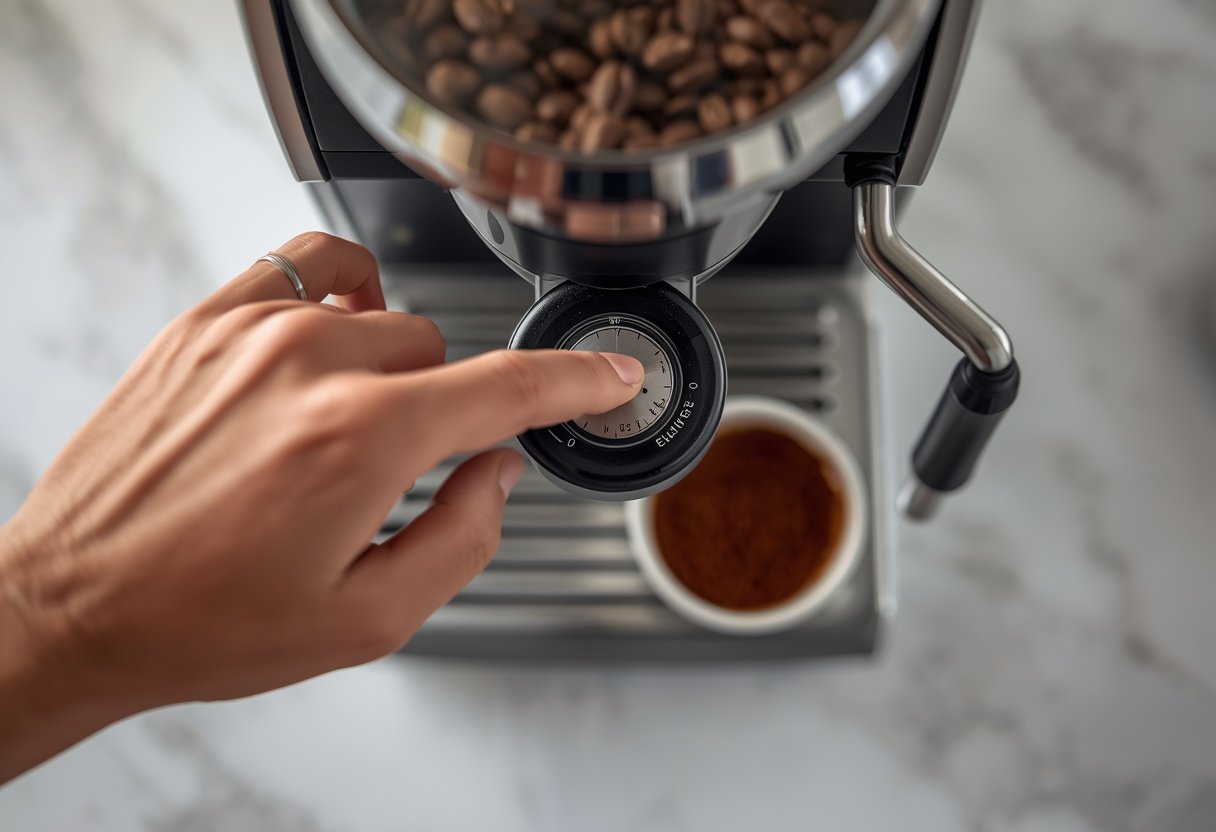
Most of the work is done at the grinder. Grind size controls how fast water passes through the coffee “puck.” Finer grounds slow the water. Coarser grounds speed it up. That speed decides how much flavor ends up in your cup.
How to Calibrate an Espresso Machine: The 4 Key Numbers
These starting numbers come from common barista guides, including Breville’s dial-in guide and Sage’s espresso guide. Use them as a base. Then adjust by taste.
| Setting | Starting point | Normal range | What it controls |
|---|---|---|---|
| Dose (coffee in) | 18 g for a double | 18 to 20 g double, 9 to 14 g single | Strength and body |
| Yield (espresso out) | About 36 g (1:2 ratio) | 1:1.5 to 1:2.5 | Sweetness and strength |
| Shot time | 25 to 30 seconds | 20 to 40 seconds can still taste good | How much flavor is pulled out |
| Water temperature | About 200°F (93°C) | 195 to 205°F (90 to 96°C) | Sour or bitter notes |
| Pressure | About 9 bar | Set by the machine on most home models | Flow and crema |
What is a 1:2 ratio? It means 2 grams of liquid espresso for every 1 gram of dry coffee. So 18 grams in gives about 36 grams out. Weigh the shot in the cup. Volume is not reliable because crema adds foam.
What You Need Before You Start
- Fresh espresso beans. Beans roasted 7 to 30 days ago work best. See our guide to the best ground coffee for espresso machine if you use pre-ground coffee.
- A kitchen scale that reads to 0.1 gram. It is the most useful tool for calibration.
- A timer. Your phone works fine.
- A burr grinder or a machine with a built-in grinder. Blade grinders make uneven grounds that are hard to calibrate.
- Good water. Hard water and very soft water both change taste. Read our best water for espresso machine guide.
- A tamper and a small cup or glass for each test shot.
How to Calibrate an Espresso Machine Step by Step
Follow these steps in order. Keep everything the same except the one setting you are testing. That way you know what made the change.
Step 1: Warm Up the Machine
Turn the machine on and let it heat for at least 15 to 20 minutes, or as the manual says. Lock the empty portafilter in so it heats too. Run a short “blank shot” of water through it. A cold portafilter makes a cold, sour shot.
Step 2: Set a Starting Grind
Pick a middle-fine setting for espresso. Many machines list a start number in the manual. If you are opening a new bag on a grinder you already use, start one step finer than before.
Step 3: Weigh Your Dose
Put the portafilter on the scale and tare it. Grind 18 grams for a double basket. If your basket is smaller, use the amount the basket is made for. Keep this dose the same for every test shot.
Step 4: Distribute and Tamp Evenly
Tap the portafilter so the grounds sit level. Press straight down with the tamper until the coffee feels firm. The tamp should be level, not tilted. A crooked tamp lets water find a weak spot. That is called channeling.
Step 5: Pull the Shot and Time It
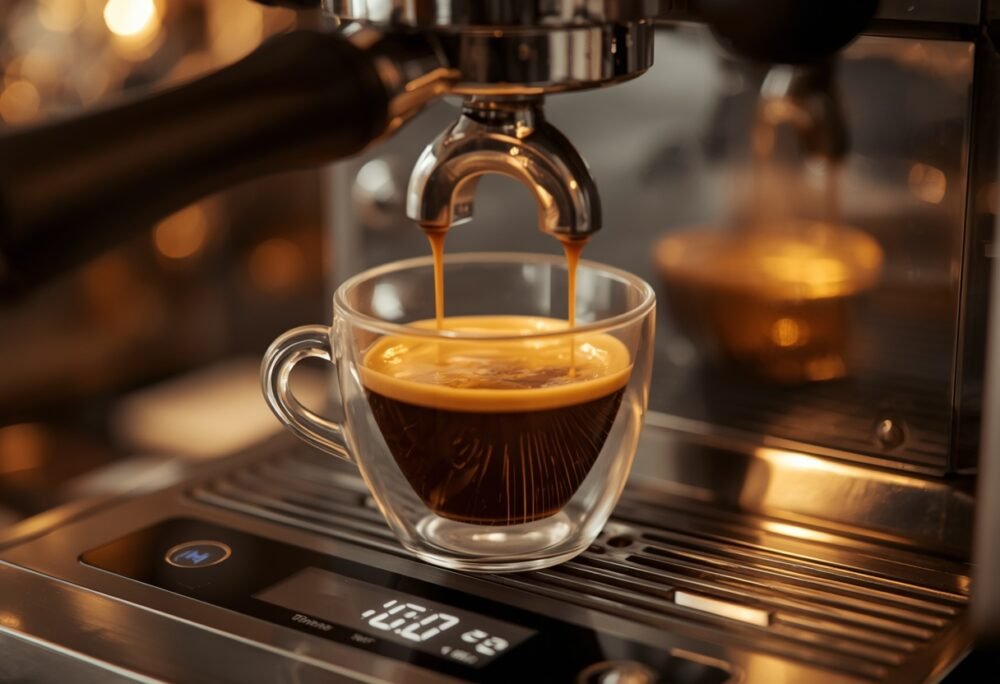
Put your cup on the scale. Start the timer when you start the pump. Stop the shot when the cup reaches your target yield, about 36 grams. Write down the time.
Step 6: Taste and Read the Shot
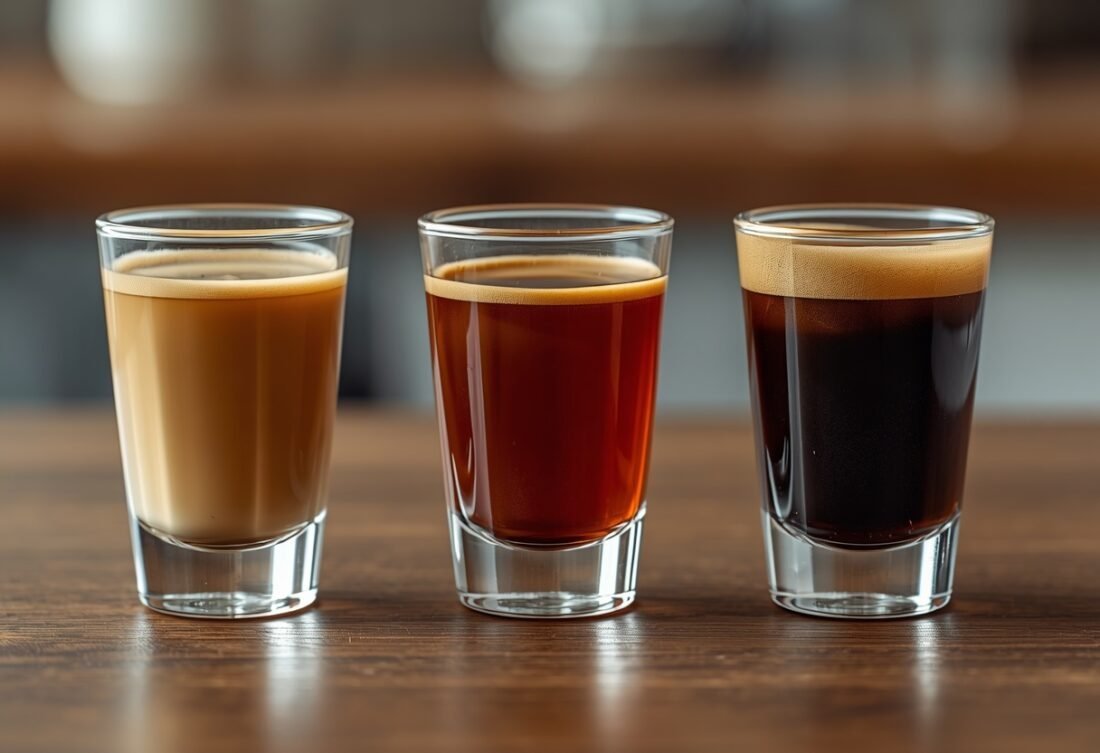
Taste it straight, even if you drink lattes. Sour, thin and salty means under-extracted. Bitter, dry and harsh means over-extracted. Sweet with a pleasant finish means you are close.
Step 7: Make One Change and Repeat
Move the grinder one step at a time. Purge a little coffee after each change, because old grounds sit inside the grinder. Pull another shot. Most people get a good shot in three to five tries.
Shot Time and Taste Chart for Calibration
Use this chart after each test shot. It tells you which way to move the grinder.
| What you see or taste | Shot time | What it means | What to do |
|---|---|---|---|
| Pale, thin, fast stream | Under 20 sec | Grind too coarse or dose too low | Grind finer by 1 to 2 steps |
| Sour, sharp, salty | 20 to 24 sec | Under-extracted | Grind finer by 1 step |
| Sweet, balanced, honey-like flow | 25 to 30 sec | Well calibrated | Keep it. Fine-tune by taste |
| Slightly bitter, heavy | 31 to 35 sec | A bit over-extracted | Grind coarser by 1 step |
| Bitter, dry, only drips | Over 35 to 40 sec | Grind too fine or dose too high | Grind coarser by 1 to 2 steps |
| Spurts or uneven streams | Any | Channeling | Level the grounds and tamp straight |
Good espresso does not always land at 25 to 30 seconds. Some light roasts taste best near 35 seconds. Some dark roasts taste best near 22 seconds. Time is only a guide, and taste decides.
How to Calibrate Breville Espresso Machine Models
If you want to know how to calibrate Breville espresso machine models, start with the grind size dial on the side. Breville machines with a built-in grinder share the same basic steps. The numbers differ by model.
| Breville model | Grind settings | Suggested start | Extra adjustment |
|---|---|---|---|
| Barista Express (BES870) | 16 (1 = finest) | Around 5, then adjust | Inner upper burr, factory set at 6 |
| Barista Pro (BES878) | 30 | Setting 15 (Breville’s advice) | Inner upper burr |
| Barista Express Impress (BES876) | 25 | Setting 16 (manual advice) | Automatic dose and tamp |
| Bambino / Bambino Plus | No grinder | Use a separate grinder | Program shot volume |
Breville gives the Barista Pro start number on its official grind size page. For other models, always check your manual too.
Breville Barista Express: Grind Size and Grind Amount
The Barista Express has two dials. The grind size dial sets how fine the coffee is. The grind amount dial sets how much coffee drops into the portafilter. Set the amount so the tamped coffee sits just below the rim. The trimming tool helps you check this.
Watch the pressure gauge. The needle should sit in the marked espresso range while the shot runs. Below that range, grind finer. Above it, grind coarser.
Breville Inner Burr: When the Dial Is Not Enough
If your shot still runs fast at setting 1, the inner burr can help. Empty the bean hopper, remove it, and lift out the upper burr. Move it one number lower for a finer range, then lock it back in. Only move one number at a time. Most people never need this step, but it helps with light roasts.
Program the Shot Volume on Breville
Out of the box, the single shot is about 30 ml and the double is about 60 ml. That can be too much espresso once you calibrate by weight. On the Barista Express, press PROGRAM, press the 1 CUP or 2 CUP button, then press it again when your cup reaches the yield you want. The machine beeps to save it. To reset, hold PROGRAM until it beeps three times.
On the Bambino, press and hold the 1-Cup and 2-Cup buttons together until they flash. Then pull the shot and press the button again to save it.
Breville Impress and Touch Models
These models measure and tamp the dose for you. They also learn and adjust the dose over time. You still need to set the grind size, because grind controls shot time. So the main job is the same: watch time, taste, and move the grind dial.
How to Calibrate DeLonghi Espresso Machine Models
How to calibrate DeLonghi espresso machine models depends on the type you own. De’Longhi makes manual machines with a grinder, fully automatic bean-to-cup machines, and small pump machines without a grinder.
| De’Longhi type | Example models | Where you adjust | Key rule |
|---|---|---|---|
| Manual with grinder | La Specialista range | Grind dial on the machine | Adjust only while grinding, one level at a time |
| Fully automatic, knob | Magnifica, Dinamica (many models) | Knob inside the bean hopper | Turn toward 1 for finer, only while grinding |
| Fully automatic, screen | PrimaDonna Soul and similar | “Adjust mill” menu on the display | Make about 5 coffees before the next change |
| No grinder (pump machine) | Dedica, Stilosa | Your separate grinder and dose | Program cup size; use fresh, fine grounds |
De’Longhi La Specialista (Manual with Grinder)
Turn the grind dial only while the grinder is running. Move one level, then make at least five coffees before you change it again. Check that the dose reaches the level marked inside the filter. Too little or too much coffee gives a weak or slow shot. On some La Specialista models, the manual lists setting 9 as the default medium grind.
De’Longhi Fully Automatic Machines
According to De’Longhi’s own help page, open the bean hopper and find the grind knob. Start a coffee. While the grinder runs, turn the knob one notch toward 1. Lower numbers mean finer. Give the machine a few coffees before you judge the change.
For daily strength, use the aroma or strength button instead of the grinder. That adds more coffee per cup. Save grinder changes for setup or a new bean type. If your machine has Bean Adapt, use it, since it sets things for your beans.
Set the Water Hardness on De’Longhi
Most De’Longhi automatic machines come with a test strip. Dip it in your tap water, read the color, and enter the hardness level in the settings. This tells the machine when to remind you to descale. Scale buildup slows flow and changes taste, so this step matters for long-term calibration.
De’Longhi Dedica and Other Machines Without a Grinder
These machines often use pressurized filter baskets. The basket makes crema even with less-than-perfect grounds. You calibrate by buying fresh espresso-grind coffee, filling the basket to the right level, and setting the cup size with the program button. Check your manual for the exact button steps on your model.
How to Calibrate Espresso Machine Starbucks Style
Many people search how to calibrate espresso machine Starbucks style. This can mean two things. Some are Starbucks staff. Others want a Starbucks-like shot at home.
In Starbucks Stores
Starbucks stores use super-automatic commercial machines (the Mastrena). The machine grinds, tamps and brews on its own. Staff follow the store’s own steps for timing and cleaning, and service is handled by the company. Barista guides widely list a shot time target of about 18 to 23 seconds. That is shorter than the 25 to 30 seconds many home guides use.
If you work at Starbucks, always follow your store manager and current training. Settings can change, and store machines are not something to adjust on your own.
Starbucks-Style Shot at Home
To get closer to the Starbucks taste at home, use a dark roast espresso blend. Keep the dose at 18 grams. Aim for a slightly shorter shot, around 20 to 25 seconds. Dark roasts get bitter fast, so a little coarser grind or a shorter yield often tastes better.
Older “Starbucks Barista” home machines were made by Saeco. Many use pressurized baskets. Calibrate them like any pump machine: fresh grounds, the right basket fill, and a set cup size.
Calibration Settings by Roast Level
| Roast | Grind | Ratio | Time | Temperature |
|---|---|---|---|---|
| Light roast | Finer | 1:2.2 to 1:2.5 | 28 to 35 sec | 201 to 205°F (94 to 96°C) |
| Medium roast | Middle | 1:2 | 25 to 30 sec | About 200°F (93°C) |
| Dark roast | A bit coarser | 1:1.5 to 1:2 | 20 to 27 sec | 195 to 198°F (90 to 92°C) |
If your machine lets you set temperature, lower it for dark beans and raise it for light beans. If it does not, change the grind and yield instead.
Pros and Cons of Calibrating Your Espresso Machine
| ✔ Pros | ✘ Cons |
|---|---|
| Much better taste from the same beans. | Uses some coffee for test shots. |
| Shots stay the same day after day. | Takes 15 to 20 minutes at first. |
| Better crema and milk drinks. | You need to redo it with new beans. |
| Less waste over time. | A scale is an extra small cost. |
| Helps you spot machine problems early. | Can feel tricky for the first week. |
What You Can and Cannot Do When Calibrating
| ✔ You can | ✘ You cannot |
|---|---|
| Change grind size, dose, yield and shot volume. | Change the pump pressure on most home machines. |
| Adjust the inner burr on many Breville grinders. | Fix a worn grinder by calibration alone. |
| Set temperature on many Breville and De’Longhi models. | Get café results from stale beans. |
| Use the aroma button for daily strength on De’Longhi. | Turn a De’Longhi grinder knob while it is not running. |
| Reset shot volumes to factory default. | Adjust a Starbucks store machine as a customer or new hire. |
| Calibrate a no-grinder machine with fresh pre-ground coffee. | Get fine control from a pressurized basket. |
Common Calibration Mistakes to Avoid
- Changing many things at once. Change one setting per shot.
- Measuring by volume. Crema makes volume misleading. Weigh the shot.
- Skipping the warm-up. A cold group head gives sour shots.
- Not purging the grinder. The first grounds after a change are from the old setting.
- Using old beans. Beans older than about a month after roast lose crema and run fast.
- Forgetting to descale. Scale slows flow and makes calibration drift.
- Judging only by time. A shot can hit 28 seconds and still taste bad.
How Often Should You Recalibrate?
| When | What to do |
|---|---|
| New machine | Full calibration from Step 1 |
| New bag of beans | Quick check, often 1 to 3 shots |
| Beans getting older | Grind a little finer over time |
| Weather or season change | Small grind tweak if time shifts |
| After descaling or a new burr | Full check of time and taste |
| Shots suddenly change | Check beans, dose and tamp first, then grind |
Keep a small note on your phone. Write the bean name, grind number, dose, yield and time. Next time you buy the same beans, you start close to the right spot.
Once your shots taste good, milk drinks get easier too. See our guide on what milk is best for espresso machine drinks. You can also read this Whole Latte Love dialing-in guide for more shot examples.
FAQ: How to Calibrate an Espresso Machine
How do I calibrate an espresso machine at home?
Warm up the machine, dose 18 grams, pull about 36 grams of espresso, and time it. Aim for 25 to 30 seconds. Grind finer if it is fast or sour, and coarser if it is slow or bitter. Change one thing at a time.
How long does it take to calibrate an espresso machine?
Most people need 15 to 20 minutes and three to five test shots. A quick check with a new bag of beans often takes one or two shots.
How do I calibrate a Breville espresso machine?
Start the grind dial at the suggested number, set the grind amount so the tamped coffee sits just below the rim, and watch the pressure gauge and shot time. Move the grind one step at a time. Reprogram the shot volume once you like the taste.
What grind setting should I use on a Breville Barista Express?
Many users start around 5 on the 16-step dial and adjust from there. If it still runs fast at 1, move the inner upper burr one number finer.
How do I calibrate a DeLonghi espresso machine?
Adjust the grinder only while it is running, one level at a time. On fully automatic models the knob is inside the bean hopper; turn toward 1 for finer. Make about five coffees before changing again. Set the water hardness too.
Why is my De’Longhi coffee watery?
The grind is often too coarse or the strength setting is low. Raise the aroma or strength first. If it is still watery, set the grinder one notch finer while it grinds.
What shot time does Starbucks use?
Barista guides widely list about 18 to 23 seconds for Starbucks store shots. Home guides often aim for 25 to 30 seconds. Store staff should follow current company training.
Can I calibrate an espresso machine without a scale?
Yes, but it is harder. Use the shot glass lines and a timer. A double shot of about 2 oz in 25 to 30 seconds is a rough start. A scale gives far more control.
Should I change the grind or the dose first?
Keep the dose fixed and change the grind first. Grind has the biggest effect on shot time. Change the dose only when you want a stronger or lighter cup.
How often should I recalibrate my espresso machine?
Do a quick check with every new bag of beans. Do a full calibration with a new machine, after descaling, or if the taste suddenly changes.
Final Thoughts
Now you know how to calibrate an espresso machine with four simple numbers. Weigh the dose, weigh the shot, time it, and taste it. Move the grinder in small steps. Whether you own a Breville, a De’Longhi or want a Starbucks-style shot, the method is the same. A few test shots today give you better coffee every morning.