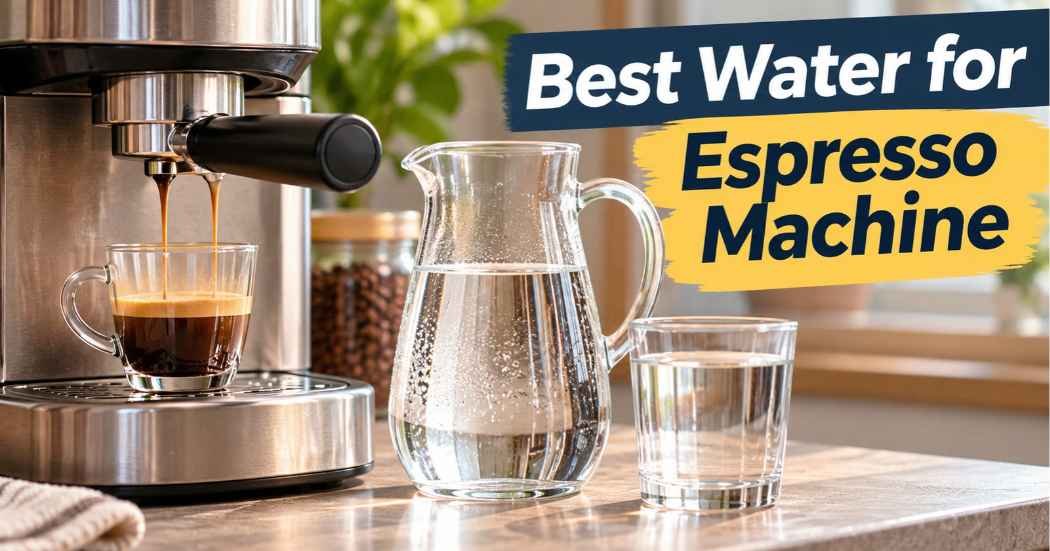
Quick answer: The best water for espresso machine use is soft, clean water that still has a small amount of minerals. Aim for about 150 mg/L total dissolved solids (TDS), low hardness, no chlorine and a pH near 7. For most homes, that means filtered tap water or a low mineral spring water such as Crystal Geyser, Poland Spring or Volvic. Do not run plain distilled or reverse osmosis (RO) water. It has almost no minerals, and many machines need some minerals to work right.
Below you will find the target numbers, a water type chart, bottled water picks, filter types, and what you can and cannot do.
Finding the best water for espresso machine use sounds like a small thing. It is not. A shot of espresso is mostly water. The water also runs through the boiler, the pump and the group head every day.
Water that is too hard leaves scale inside the machine. Water that is too pure can confuse the sensors and taste flat. The right water sits in the middle. This guide shows you where that middle is and how to get there with tap, filtered or bottled water.
Why Water Matters for Your Espresso Machine
Water does two jobs in an espresso machine. It pulls flavor out of the coffee. It also passes through hot metal parts again and again. Both jobs depend on what is dissolved in it.
- Scale. Calcium and magnesium in hard water turn into scale when heated. Clive Coffee calls scale from hard water the single biggest cause of espresso machine failure. Scale can clog pipes, slow heating and break sensors.
- Taste. Some minerals help pull out sweetness and body. Too much buffering (alkalinity) makes espresso taste flat and chalky. Chlorine adds a pool-like taste.
- Sensors. Many machines check the water level with a small electric current. Water with no minerals does not carry that current well. La Marzocco says distilled water is a common cause of a “reservoir empty” alert on its GS3 and Linea Mini.
- Corrosion. Very pure water with almost no alkalinity can attack metal parts in a hot boiler over time.
Ideal Water Numbers for Espresso (SCA Targets)
The Specialty Coffee Association (SCA) publishes a water standard for brewing coffee. Most machine makers and coffee shops use it as a starting point. Here are the main numbers.
| What to measure | SCA target | Acceptable range |
|---|---|---|
| Total dissolved solids (TDS) | 150 mg/L | 75 to 250 mg/L |
| Calcium hardness | 68 mg/L (as CaCO3) | About 17 to 85 mg/L |
| Total alkalinity | About 40 mg/L | At or near 40 mg/L |
| pH | 7.0 | 6.5 to 7.5 |
| Sodium | About 10 mg/L | Keep it low |
| Chlorine | 0 mg/L | None, no odor or color |
TDS is only a total. It does not tell you which minerals are in the water. Two waters with the same TDS can act very differently in a boiler. That is why hardness and alkalinity are worth checking on their own.
Machine makers can be stricter than the SCA. Some espresso brands publish their own water specs and online calculators. Always check your manual first, because your warranty may depend on it.
Best Water to Use for Espresso Machine: Every Type Compared
Here is how the common water choices stack up. Use it to pick the best water to use for espresso machine setups in your home.
| Water type | Safe for the machine? | Notes |
|---|---|---|
| Filtered tap water (soft area) | Yes | Often the easiest choice. A filter removes chlorine and off tastes. |
| Filtered tap water (hard area) | Only with a softening filter | A plain carbon filter does little for hardness. Use a cartridge that reduces scale. |
| Unfiltered hard tap water | No | Fast route to scale and repair bills. |
| Low mineral spring water | Yes | Easy and consistent. Check the mineral label first. |
| High mineral water (some European brands) | Not on its own | Too hard for most boilers. Some people mix it with softer water. |
| Sparkling water | No | Gas and high minerals do not belong in a boiler. |
| Softened water (ion exchange) | Usually | Swaps calcium and magnesium for sodium. Stops scale, but very high sodium can change taste. |
| Plain distilled water | No | Almost no minerals. Can trip level sensors and taste flat. |
| Plain reverse osmosis (RO) water | No | Same problem as distilled. RO systems for coffee add minerals back. |
| Distilled or RO water plus an espresso mineral packet | Yes | Gives you a set recipe every time. Costs more effort. |
Best Bottled Water for Espresso Machines
Bottled water is the simplest fix if your tap water is very hard or full of chlorine. La Marzocco even calls bottled water its number one recommendation for people starting out. The catch is that brands and even bottling sources differ. Always read the mineral analysis on the label or the brand’s website.
These are the names that come up most often when people look for the best bottled water for espresso machine use.
| Bottled water | Why people use it | What to watch |
|---|---|---|
| Crystal Geyser Alpine Spring Water | Low in minerals and easy to find in the US. La Marzocco names it as an option. | Minerals change by bottling plant. La Marzocco names the California and South Carolina sources. Check the label. |
| Poland Spring | La Marzocco lists it as a good choice on the US east coast. | Spring sources vary. Confirm the numbers for your bottle. |
| Volvic | Popular with home baristas for its balanced, moderate minerals. | Harder to find in some US stores. Costs more than store brands. |
| Acqua Panna | Often named by espresso shops for its smooth taste. | A little harder than the others. Expect some scale and descale on time. |
| Evian | Rich mineral taste. | High mineral content. Many home baristas mix it 50/50 with filtered or distilled water. |
| Sparkling and high mineral waters | None for espresso machines. | Avoid. Too many minerals and added gas. |
How to read a bottled water label
- Look for TDS (sometimes called “dissolved solids”) between about 75 and 150 mg/L for espresso.
- Check calcium and magnesium. Lower numbers mean less scale.
- Check bicarbonate. Very high bicarbonate makes espresso taste dull.
- Check chloride. High chloride can be hard on boiler metals.
- Find the source or plant. The same brand can bottle very different water in different places.
Tip: Bottled water costs add up if you pull many shots a day. It works best for small machines with a water tank, or as a backup while you set up a filter.
Best Water Filter for Espresso Machine Use
A filter is cheaper than bottled water over time. The best water filter for espresso machine use depends on how hard your tap water is. Here are the main types.
| Filter type | What it does | Best for |
|---|---|---|
| Machine brand in-tank cartridge | Sits in the water tank. Cuts chlorine and some hardness. Made to fit your model. | Soft to medium water, home machines with a tank |
| Carbon pitcher filter | Cuts chlorine, smell and taste. Plain carbon does little for scale. | Soft water that tastes of chlorine |
| Pitcher or cartridge with ion exchange resin | Lowers carbonate hardness, so less scale forms. | Medium to hard water |
| Espresso water cartridges (for example BWT) | Made for espresso machines. La Marzocco sells BWT cartridges for scale and corrosion control. | Plumbed in or high end machines |
| RO system with remineralization | Strips almost everything, then adds a set amount of minerals back. | Very hard or high chloride water |
Change filter cartridges on schedule. An old cartridge stops softening, and you may not notice until scale builds up. Most in-tank filters list a time or a number of liters on the box.
Can You Use Distilled or RO Water in an Espresso Machine?
Plain distilled or RO water seems like a smart way to stop scale. Most experts say no. Here is why.
- Many machines use mineral content to sense water in the tank or boiler. With pure water, the machine may think it is empty or keep filling.
- Water with no buffering can become aggressive on hot metal and pull ions from the boiler.
- Espresso made with mineral-free water tends to taste flat and thin.
The fix is to add minerals back. Mineral packets such as Third Wave Water Espresso Profile are made for this. You add one packet to one gallon of distilled or RO water and shake. Third Wave Water’s Classic Profile is a different blend and is not meant for espresso machines, so buy the espresso version. You still need to descale as normal.
Check your manual: Some brands allow distilled water and some ban it. A few prosumer machines with sealed boilers have their own rules. If the manual and this guide disagree, follow the manual.
How to Test Your Water at Home
- Get your city water report. Most water suppliers post a yearly report with hardness and TDS.
- Use a TDS meter. It is cheap and quick. It shows total minerals but not which ones.
- Use hardness test strips or a drop kit. These show general hardness (GH) and carbonate hardness (KH). Drop kits are more exact.
- Test cold water. La Marzocco says to test cold water from the tap, filter or bottle, not hot water from the machine.
- Test again every few months. City and well water can change with the seasons.
How to Pick the Best Water for Your Espresso Machine
| Your tap water | What to use |
|---|---|
| Soft, little chlorine taste | Tap water through a carbon or in-tank filter. |
| Soft, strong chlorine taste | Carbon filter, then retest the taste. |
| Medium hardness | Softening cartridge (ion exchange) or low mineral bottled water. |
| Very hard | Low mineral bottled water, distilled water plus an espresso mineral packet, or RO with remineralization. |
| High chloride or unknown well water | Test first. Bottled water or RO with remineralization until you know more. |
What You Can and Cannot Do
✔ You can
- Use filtered tap water if it is soft.
- Use low mineral spring water after checking the label.
- Mix a hard bottled water with distilled water to soften it.
- Use distilled or RO water with an espresso mineral packet added.
- Use your machine brand’s own filter cartridge.
- Empty and refill the tank with fresh water every day or two.
✘ You cannot
- Run plain distilled or RO water in most machines.
- Use sparkling or flavored water.
- Use very hard tap water without treatment.
- Use a coffee mineral blend made for drip brewers in an espresso machine.
- Skip descaling because you use filtered or bottled water.
- Keep an old filter cartridge past its change date.
Pros and Cons: Bottled Water vs Filtered Water
Bottled water
✔ Pros
- No setup, ready the day your machine arrives
- Mineral numbers are on the label
- Same water batch after batch from one source
✘ Cons
- Costs more over time
- Lots of plastic waste
- Minerals can change by bottling plant
Filtered water
✔ Pros
- Cheaper per cup over time
- No bottles to carry home
- Removes chlorine taste
✘ Cons
- Results depend on your tap water
- Cartridges need regular changes
- Plain carbon filters do not stop scale
Good Water Still Needs Descaling
Even soft water leaves a little scale over time. Descale as your manual says. Hard water areas need it more often. Use the descaler your machine maker recommends, and rinse well after. If your machine has a water hardness setting, set it to match your test result so the descale alert comes at the right time.
FAQ: Best Water for Espresso Machine
What is the best water for espresso machine use?
Soft, clean water with some minerals. Aim for about 150 mg/L TDS, low hardness, no chlorine and a pH near 7. Filtered soft tap water or a low mineral spring water works for most people.
What is the best bottled water for espresso machines?
Low mineral spring waters are the usual picks. La Marzocco names Poland Spring on the US east coast and Crystal Geyser bottled in California or South Carolina. Volvic is also popular. Check the label because sources differ.
What is the best water filter for espresso machine use?
Your machine brand’s in-tank cartridge is a good start for soft to medium water. For hard water, pick a filter with ion exchange resin or an espresso cartridge such as BWT. For very hard water, use RO with remineralization.
Can I use distilled water in my espresso machine?
Not on its own in most machines. It has almost no minerals, which can upset level sensors and make espresso taste flat. Add an espresso mineral packet to it instead.
Is tap water OK for an espresso machine?
Only if it is soft and low in chlorine. Most tap water is better after a filter. Hard tap water should never go in untreated.
Is Evian good for espresso?
Evian is high in minerals, so it can leave scale on its own. Many home baristas mix it half and half with filtered or distilled water.
Does Brita water work in an espresso machine?
A pitcher filter helps with chlorine and taste. How much it cuts hardness depends on the cartridge. If your water is hard, choose a cartridge that lists scale or hardness reduction.
Do I still need to descale if I use bottled or filtered water?
Yes. Good water slows scale, but it does not stop it fully. Follow the descale schedule in your manual.
How often should I change the water in the tank?
Fresh water tastes better. Empty and refill the tank every day or two, and rinse it now and then.
Final Thoughts
The best water for espresso machine use is soft, chlorine-free water with a small amount of minerals. Test your tap water first. If it is soft, a filter is often all you need. If it is hard, switch to low mineral bottled water, a softening filter, or distilled water with an espresso mineral packet. Then keep descaling on schedule, so scale never gets a chance to build up.
Sources and further reading: La Marzocco Home on water for espresso machines, Clive Coffee on soft, filtered water, and Seattle Coffee Gear on hard water.
Related reading on MiniKitchenPro