

Best Japanese Rice Cooker: Quick Answer
The best Japanese rice cooker is one that suits your household size and the rice you cook. This guide covers 7 models: four Zojirushi and Toshiba compact cookers, and larger options for families.
| Model | Capacity (from the listing) | Highlights from the title | Best for |
|---|---|---|---|
| Zojirushi Micom 3-Cup | 3-cup | Compact, multiple settings, stainless steel, retractable power cord | Small kitchens |
| Zojirushi NS-ZCC10 | Not in title | Neuro Fuzzy, rice cooker and warmer | Careful rice cooks |
| Toshiba OriginTaste | 5.5-cup uncooked | Fuzzy logic, 15-in-1, digital display, delay timer | Families |
| COMFEE’ Rice Cooker | 6 cups uncooked / 12 cooked | Fuzzy logic, 24-hour timer, 11 presets, steamer | Larger households |
| Zojirushi NS-TSC10 | 5.5-cup | Micom, rice cooker and warmer, 1.0 L | Everyday family use |
| Toshiba Mini | 3 cups uncooked | For 1 to 3 people, fuzzy logic, 24-hour delay timer, auto keep warm | Singles and couples |
| Zojirushi 3-Cup (White) | 3-cup | Rice cooker and steamer | Simple, small batches |
How We Chose These Japanese Rice Cookers
We have not tested these cookers ourselves. We checked each product link against its Amazon listing title and kept only details that the title states. Rice-prep tips follow Just One Cookbook’s rice guide. We leave out prices and ratings because they change.
What Makes a Rice Cooker “Japanese”?
Japanese rice is short-grain rice. It cooks soft and slightly sticky. It needs the right water level and gentle, even heat. Many Japanese-style cookers add smart controls to manage this.
| Term | What it means | Why it matters |
|---|---|---|
| Micom | A small computer chip controls heat and time | More even results than a basic on/off cooker |
| Fuzzy logic | The cooker adjusts heat as the rice cooks | Helps with different batch sizes |
| Neuro Fuzzy | Zojirushi’s name for its smarter fuzzy logic | Aims for steady results |
| Keep warm | Holds cooked rice warm after cooking | Useful if meals are not at the same time |
| Delay timer | Starts cooking at a time you set | Rice ready when you get home |
| Steamer | Lets you steam food with the rice | One appliance for more meals |
The 7 Best Japanese Rice Cookers
1. Zojirushi Micom 3-Cup Rice Cooker and Warmer

Key features: Micom control, 3-cup size, multiple settings, stainless steel build, retractable power cord, rice cooker and warmer, per the listing.
Pros
compact and easy to move. The cord tucks away for storage.
Cons
3 cups suits one to three people, not a big family.
Best for: small kitchens, couples and anyone short on counter space.
2. Zojirushi NS-ZCC10 Neuro Fuzzy Rice Cooker and Warmer

Key features: Neuro Fuzzy control, rice cooker and warmer, white, per the listing. The title does not state the capacity, so check the listing.
Pros
smart heat control aimed at steady rice. Includes a warmer.
Cons
a premium-style cooker with more controls to learn. Confirm the size before you buy.
Best for: people who cook rice often and want smart control.
3. Toshiba OriginTaste 5.5-Cup Rice Cooker

Key features: 5.5-cup uncooked capacity, fuzzy logic, 15-in-1 functions, digital display, delay timer, keep warm, nonstick inner pot, per the listing.
Pros
many functions in one cooker. A digital display and timer make it easy to plan meals.
Cons
a nonstick pot needs gentle tools and care. Many functions mean a short learning period.
Best for: families who also cook other grains and dishes.
4. COMFEE’ 6-Cup Japanese Rice Cooker
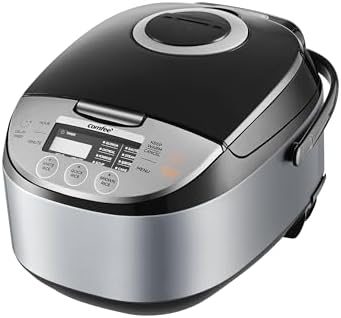
Key features: 12 cups cooked / 6 cups uncooked, portable, non-stick, fuzzy logic, 24-hour timer delay, 11 presets, steamer, fast cooking, grain cooker, per the listing.
Pros
larger capacity for families. Presets cover different rice and grain types.
Cons
bigger footprint than the 3-cup models. A non-stick pot needs careful cleaning.
Best for: larger households and batch cooking.
5. Zojirushi NS-TSC10 5.5-Cup Micom Rice Cooker

Key features: 5.5-cup capacity, Micom control, rice cooker and warmer, 1.0 L, per the listing.
Pros
a mid-size choice for a family of three to five. Micom control and a warmer.
Cons
takes more counter space than the 3-cup models.
Best for: everyday family rice.
6. Toshiba Mini 3-Cup Rice Cooker

Key features: 3 cups uncooked, for 1 to 3 people, steamer and warmer, fuzzy logic, one-touch cooking, 24-hour delay timer, auto keep warm, per the listing.
Pros
one-touch cooking is simple. The delay timer helps with planning.
Cons
too small for a big family.
Best for: singles, couples and dorm or small-apartment cooks.
7. Zojirushi 3-Cup Rice Cooker and Steamer (White)

Key features: 3-cup rice cooker and steamer, white, per the listing.
Pros
simple design from a Japanese rice cooker brand. It also steams.
Cons
the title lists no micom or fuzzy logic, so it is more basic than the smart models above.
Best for: simple, small-batch rice.
How to Choose the Best Japanese Rice Cooker
| Factor | What to check |
|---|---|
| Household size | 1 to 3 people: a 3-cup model. Families: 5.5 cups or more. |
| Control type | Micom or fuzzy logic gives steadier results than a basic cooker. |
| Timer | A delay timer is handy if you cook before or after work. |
| Keep warm | Check that the cooker holds rice warm after cooking. |
| Inner pot | Non-stick pots need soft tools. Check that the lid and pot are easy to wash. |
| Extra functions | Steaming and grain presets add use. Skip them if you only cook rice. |
| Counter space | Measure your space. Bigger cookers take more room. |
How to Cook Japanese Rice in a Rice Cooker
- Measure with the cooker cup. A Japanese rice cooker cup is 180 ml, according to Just One Cookbook. It is smaller than a US measuring cup.
- Rinse well. Use cold water. Rub the rice gently until the water is almost clear.
- Soak. The guide suggests 20 to 30 minutes before cooking.
- Add water. Use the water lines inside the pot for your rice type. Do not guess.
- Rest, then fluff. Let the rice sit covered for about 10 minutes after cooking. Fluff it with a rice paddle.
- Store leftovers. Cool the rice, then freeze it in airtight containers. The guide advises against the fridge because rice gets hard there.
Care and Cleaning
| Part | What to do |
|---|---|
| Inner pot | Let it cool, then wash with a soft sponge. Do not use metal tools on a non-stick pot. |
| Lid and steam vent | Wipe after each use so rice starch does not build up. |
| Outside body | Wipe with a damp cloth. Never put the base in water. |
| Manual | Follow the maker’s care steps for your model. |
Japanese Rice Cooker Pros and Cons
Pros
- Smart controls for steadier rice
- Keep-warm and timer features
- Works for steaming and grains on many models
- Frees up a burner
Cons
- Costs more than basic cookers
- Takes counter space
- Non-stick pots need gentle care
- Many settings take time to learn
Final Verdict: Best Japanese Rice Cooker
Choose a 3-cup model for one to three people. Choose the Zojirushi NS-TSC10 or Toshiba OriginTaste for a family. Choose the COMFEE’ if you cook larger batches. Choose the NS-ZCC10 if you want Neuro Fuzzy control, after you check its capacity on the listing. Also see our best CUCKOO rice cooker and CUCKOO 6-cup rice cooker guides for other brands.
Best Japanese Rice Cooker: FAQ
What is the best Japanese rice cooker?
It depends on your household. A 3-cup Zojirushi or Toshiba suits one to three people. The 5.5-cup models suit families.
Is a Japanese rice cooker better than a regular one?
Many Japanese-style cookers use micom or fuzzy logic controls. These aim for steadier results than basic on/off cookers.
Can I make sushi rice in a regular rice cooker?
Yes. Cook short-grain rice as normal, then season it after cooking in the usual way for sushi.
How big a cooker do I need?
The Toshiba Mini lists 1 to 3 people for 3 cups uncooked. For four or more people, look at 5.5 cups or larger.
How much water should I use?
Use the water lines in your cooker’s pot. For stovetop rice, Just One Cookbook suggests a 1:1.1 to 1.2 rice-to-water ratio by volume.
Should I soak the rice first?
The Just One Cookbook guide suggests soaking for 20 to 30 minutes. Check your cooker’s manual too.
Do these cookers also steam food?
The COMFEE’, Toshiba Mini and Zojirushi 3-cup white list a steamer. Check each listing for details.
Do prices change?
Yes. Check the current Amazon listing before you buy.



Leave a Reply